
Every gemstone business eventually asks the same question: where should the next marketing dollar go? Organic content and reputation take time to compound, but paid advertising offers something organic strategies can't — immediate visibility in front of people actively searching or scrolling. The problem is that most gemstone dealers approach Google Ads and Facebook Ads as interchangeable options, choosing based on whichever platform a competitor happens to be using, rather than understanding that these two channels serve fundamentally different points in the buyer's journey.
Getting this distinction right isn't a minor technical detail. For a category where a single sale can represent thousands or tens of thousands of dollars, the difference between advertising to the right intent at the right moment and simply buying generic impressions can determine whether a marketing budget generates real revenue or quietly disappears.
Two Different Kinds of Intent
The most important thing to understand before spending a dollar on either platform is that Google Ads and Facebook Ads capture buyers in fundamentally different mental states.
Google Ads operates on intent that already exists. Someone searching "loose sapphire for sale" or "certified ruby dealer" has already decided, at least in part, that they're interested in acquiring a gemstone, and they're actively looking for who to buy it from. Google Ads puts a business directly in front of that existing demand at the exact moment it's being expressed.
Facebook Ads, by contrast, operates on intent that doesn't yet exist in an active, searchable form. Nobody wakes up and opens Facebook specifically looking for a sapphire dealer. Instead, Facebook Ads work by interrupting someone's scroll with a compelling visual — a striking gemstone photo or video — and creating interest where none was actively being expressed a moment earlier.
Avi-Meir Zaslavsky, founder of 999Precious, frames the distinction plainly. "Google Ads answers a question someone is already asking," Avi-Meir Zaslavsky explains. "Facebook Ads has to make someone ask the question in the first place. Both can work extremely well, but they're not solving the same problem, and treating them like the same budget line item is how businesses waste money on both."

Where Google Ads Excels for Gemstone Businesses
Because Google Ads captures existing search intent, it tends to perform best for gemstone businesses in scenarios where a buyer already knows roughly what they want and is comparing specific options.
Strong use cases include:
- Specific stone or category searches — "loose emerald for sale," "certified Ceylon sapphire," "GIA certified ruby" — where the searcher has already narrowed their interest considerably
- Appraisal and evaluation services — "gemstone appraiser near me" or "sapphire authentication service" capture immediate, often time-sensitive needs
- Branded competitor searches, where bidding on relevant terms can capture buyers actively comparing dealers
- High-intent, lower-funnel keywords generally, since Google Ads tends to reward specificity — a campaign built around broad terms like "gemstones" will burn budget quickly on unqualified clicks, while narrow, specific keyword targeting converts far more efficiently
The tradeoff is cost. Because Google Ads pricing is driven by auction dynamics tied to keyword competitiveness, terms with strong commercial intent in the fine jewelry and gemstone space can carry a meaningfully higher cost-per-click than many other retail categories, particularly for broad or highly competitive terms. This makes precise keyword selection and tightly matched ad copy essential — a wasted click on an expensive keyword is a genuinely costly mistake at scale.
Where Facebook Ads Excel for Gemstone Businesses
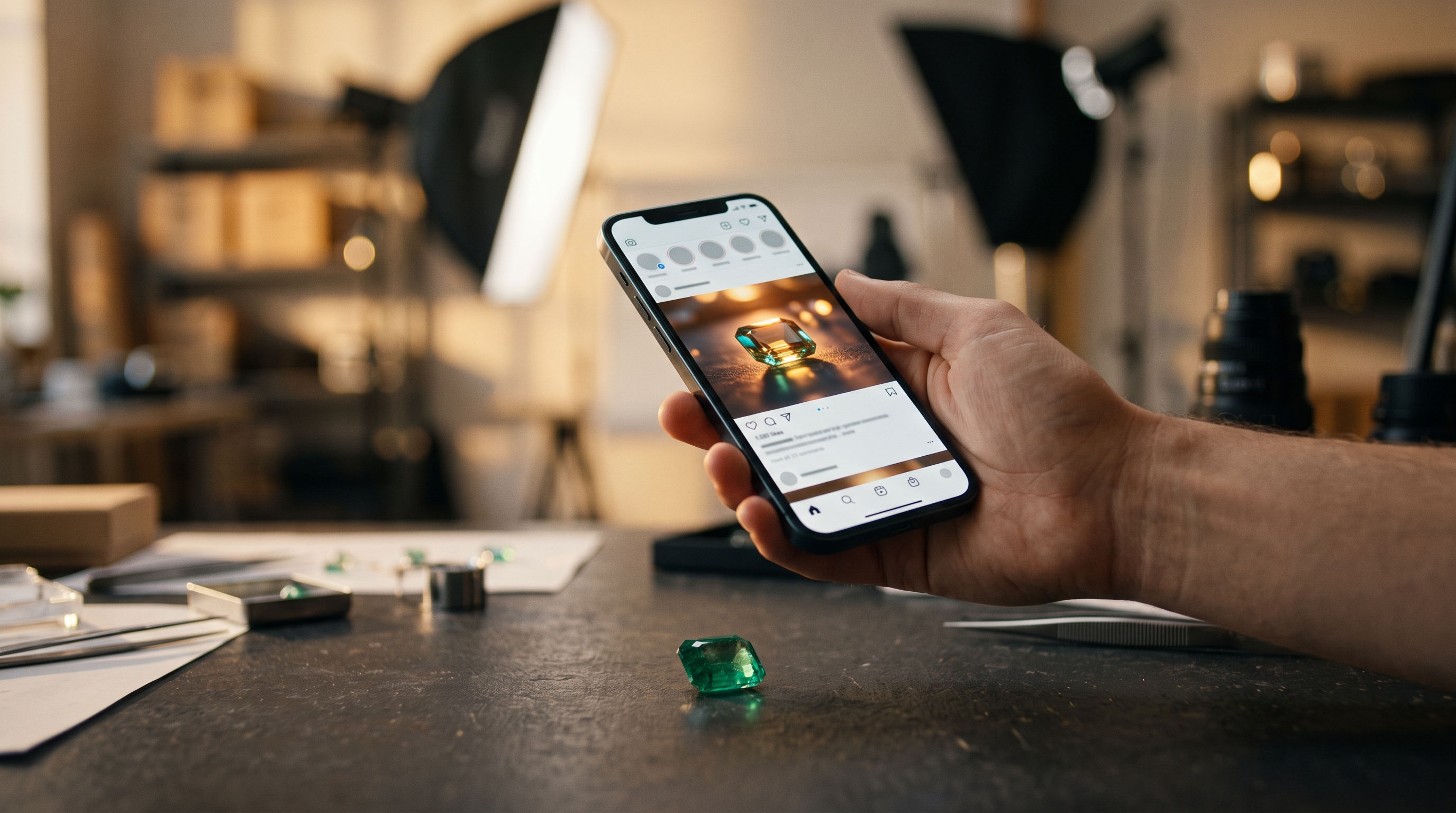
Facebook Ads (including Instagram, given the shared ad platform) play to a different strength entirely: the emotional, visual nature of fine gemstones. Because these platforms are built around image and video consumption rather than text-based search, they're particularly well suited to categories where the product itself is genuinely beautiful to look at.
Strong use cases include:
- Building awareness and desire for a category the viewer wasn't actively searching for, such as introducing collectors to a lesser-known stone type they might not have considered
- Retargeting website visitors who viewed a specific stone or category but didn't convert, using dynamic ads showing the exact item they browsed
- Lookalike audience targeting built from existing customer lists, reaching new potential buyers who share characteristics with past purchasers
- Video content showcasing light interaction, facets, and color depth, which performs particularly well in feed and story placements
- Top-of-funnel brand building for a business still establishing recognition in a market, where the goal is generating future demand rather than capturing existing demand
"Facebook is where we introduce someone to a stone they didn't know they wanted," notes Avi-Meir Zaslavsky. "Google is where we show up once they've already decided they want it. If you only run one of these, you're either missing the people just discovering you or the people already ready to buy."
Comparing Cost Structures and What They Actually Mean
Cost-per-click and cost-per-lead figures vary significantly by market, targeting precision, and seasonal demand, so any specific number should be treated as a general reference point rather than a guarantee. That said, some structural patterns tend to hold consistently across the category.
Google Ads costs are driven primarily by keyword competitiveness. Highly specific, high-intent keywords in the fine gemstone space often carry a meaningfully higher cost-per-click than broader retail categories, precisely because the commercial value of a conversion is so high — a business can rationally justify a high cost-per-click when a single conversion might be worth thousands of dollars. This means Google Ads campaigns for gemstone businesses often show a smaller volume of clicks but a notably higher conversion rate per click, since the traffic itself is pre-qualified by intent.
Facebook Ads typically carry a lower cost-per-click or cost-per-impression than competitive Google keywords, but with a correspondingly lower average intent per click, since the audience wasn't actively searching. This generally translates into more top-of-funnel engagement — saves, shares, profile visits, follows — relative to the volume of immediate sales inquiries, particularly for higher-priced items requiring more consideration before purchase.
The practical implication is that comparing raw cost-per-click across platforms without accounting for intent differences leads to flawed conclusions. A higher cost-per-click on Google generating a qualified inquiry can easily outperform a cheaper Facebook click that never converts, while a well-targeted Facebook campaign building a retargeting audience can generate conversions weeks or months later that wouldn't show up in same-day performance metrics.

Building a Strategy That Uses Both Channels Together
Rather than choosing one platform over the other, the most effective approach for most gemstone businesses treats Google Ads and Facebook Ads as complementary parts of a single funnel rather than competing options.
A layered approach typically looks like:
- Facebook and Instagram campaigns generate awareness and traffic through visually compelling content, introducing new audiences to specific stones, collections, or the business generally
- Website visitors from those campaigns are added to a retargeting pool, since a single exposure rarely converts a considered, high-value purchase immediately
- Retargeting ads on Facebook re-engage that same audience with more specific content — the exact stone they viewed, complementary pieces, or a limited-time viewing opportunity
- Google Ads captures the portion of that same audience who, having been introduced to the business, later searches directly for the business name or a related specific term, closing the loop between awareness and conversion
- Search campaigns continue running independently to capture buyers who arrive with pre-existing intent unrelated to any prior Facebook exposure
"We stopped thinking about these as separate budgets years ago," Avi-Meir Zaslavsky says. "Facebook often plants the seed, and Google is frequently where the harvest actually happens, sometimes weeks later, under a completely different search term. If you only measure each platform in isolation, you miss how much they're actually feeding each other."
Creative and Landing Page Considerations
Regardless of platform, the quality of creative assets and the landing experience they lead to significantly affects performance. For gemstone businesses specifically, a few considerations matter more than in most other retail categories:
- Color accuracy in ad imagery and video is critical, since a gemstone's color is often central to its value proposition, and misleading imagery creates trust problems that surface later in the sales process
- Landing pages should match the specificity of the ad, sending a click on "certified sapphire dealer" to a relevant, specific page rather than a generic homepage
- Certification and credibility signals should appear early on any landing page receiving paid traffic, since cold traffic in particular needs faster trust-building than an organic visitor who arrived through a referral or extensive prior research
- Clear, low-friction next steps — a consultation request, a specific inquiry form, a click-to-call button — reduce the drop-off between an interested click and an actual lead

Budget Allocation and Testing
Because performance varies meaningfully by market, price point, and specific stone category, most gemstone businesses benefit from treating early paid advertising spend as a structured test rather than committing heavily to one channel from the outset. A reasonable approach involves running smaller, parallel campaigns on both platforms initially, tracking cost-per-lead and — critically — actual conversion to sale rather than surface-level engagement metrics, before scaling budget toward whichever combination proves most efficient for that specific business's price point and audience.
It's also worth revisiting allocation periodically rather than treating an initial split as permanent. Seasonal factors, new inventory categories, and shifting platform costs can all shift which channel deserves a larger share of budget at any given time.
Bringing It Together
Google Ads and Facebook Ads aren't competing strategies for gemstone businesses — they're tools built for different moments in a buyer's decision-making process. Google Ads captures demand that already exists; Facebook Ads creates demand that didn't exist a moment before. Businesses that understand this distinction, and build campaigns that work together across the full journey from discovery to search to conversion, tend to generate far more value from their paid advertising budget than those treating the two platforms as interchangeable line items competing for the same dollars.
"Neither platform replaces the other," Avi-Meir Zaslavsky reflects. "The businesses that get the most out of paid advertising are the ones who stop asking which platform is better, and start asking what job each one is actually doing inside the bigger picture."
For gemstone businesses willing to build that kind of integrated approach, paid advertising stops being a guessing game and becomes a genuinely measurable, compounding part of the overall growth strategy.



.png)